To read in English,
please read the blu writes. Many thanks.
To read in English,
please read the blu writes. Many thanks.
ELECTRONIC KEYS and KEYERS
Key e Keyer elettronici
Si definiscono Key o keyer elettronici tutti quegli strumenti con il sistema elettronico installato a bordo del tasto, oppure dei sistemi elettronici (oscillatori) operanti mediante l'abbinamento di un paddle o un di un tasto mono pala.
Quest'ultima combinazione è quella attualmente più utilizzata in campo radiomatoriale.
Electronic keys or keyers are defined as all those instruments with the electronic system installed on the key, or electronic systems (oscillators) operating through the combination of a paddle or a single-blade key.
The latter combination is currently the most widely used in amateur radio.
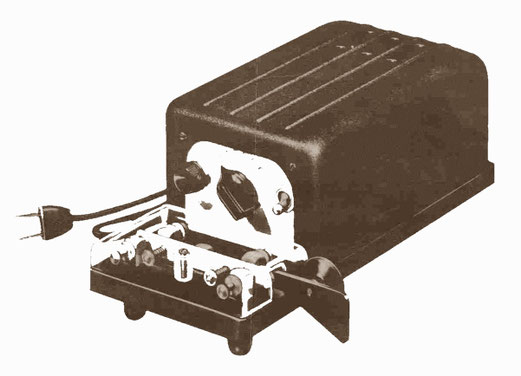
The MON-KEY.
KY.US.001
Il Mon-Key è stata la prima chiave elettronica prodotta e commercializzata per il mondo radioamatoriale.
Prodotta dal 1947 sino al 1958 dalla M.f.g. Electric Eye Equipment Co. di Danville (IL).
Il Mon-key veniva venduto munito di una scatola di contenimento, al suo interno oltre al Keyer, trovavano posto i documenti con lo schema elettrico di dettaglio e il manuale d’uso.
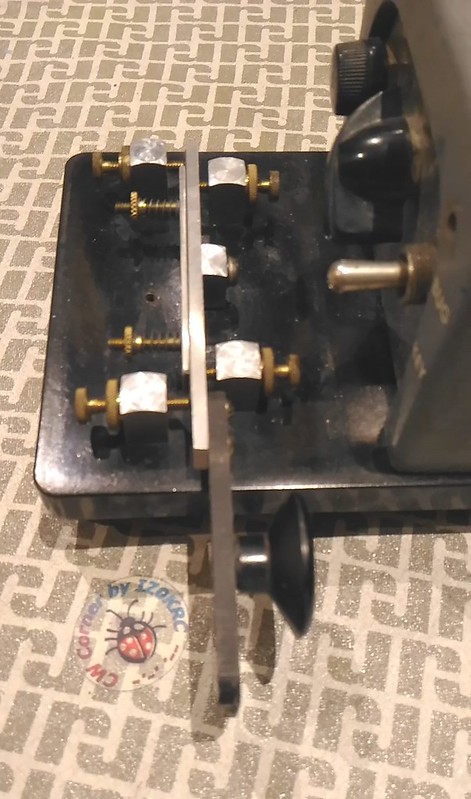
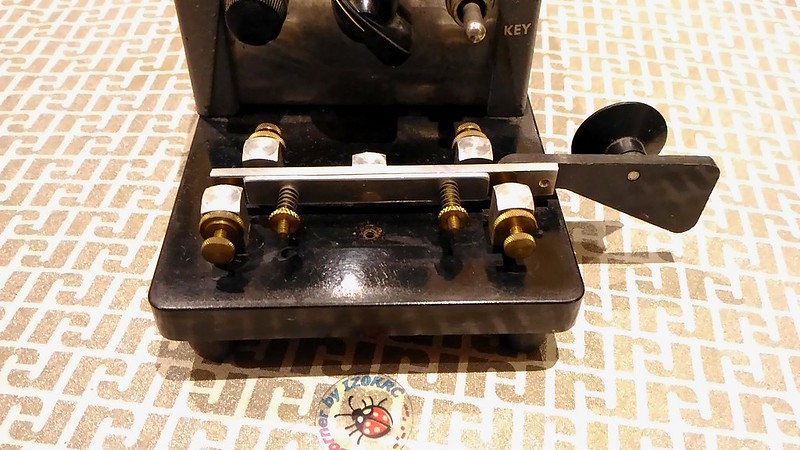
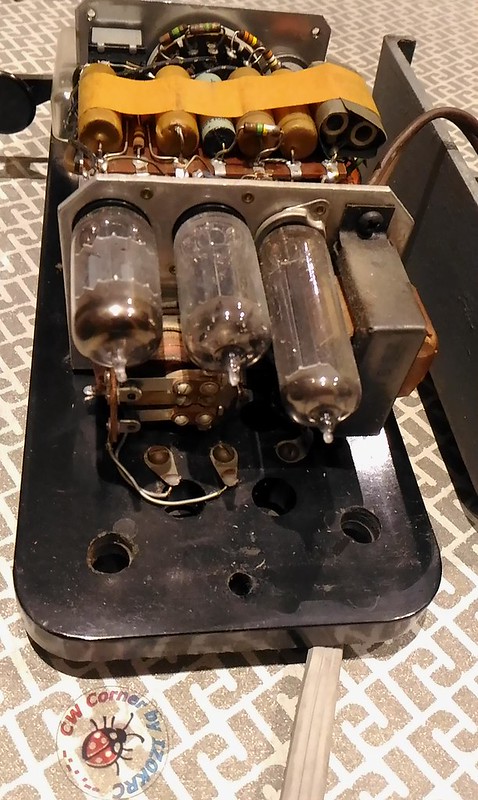
Il set telegrafico consisteva in un unico monoblocco, parte elettronica e paddle meccanico poggiati su una spessa base di bachelite, il top metallico copriva la parte elettronica, mentre il paddle era protetto da un coperchio in plexiglass. Il keyer funzionava con tensione di rete a 110 ~ 120 volts. continua.
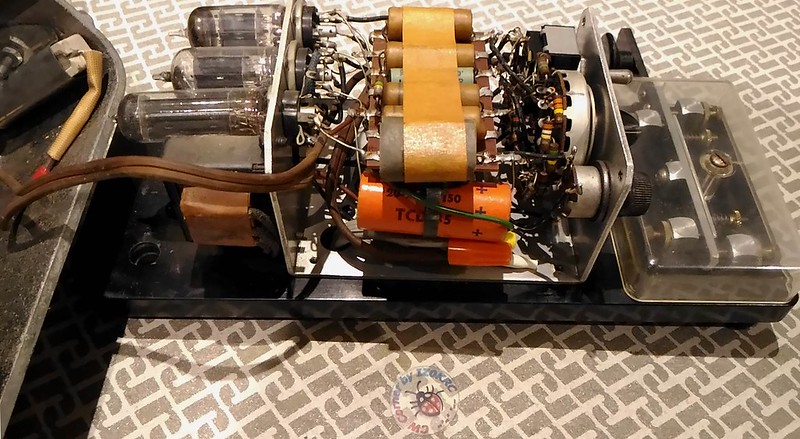
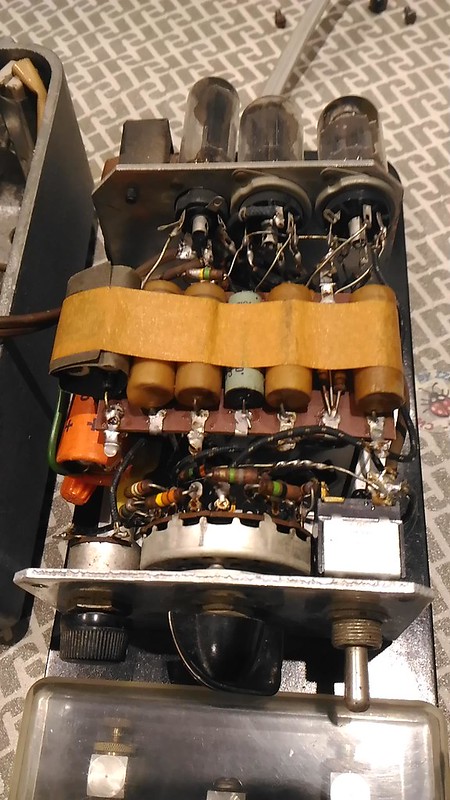
Il Mon-Key non utilizzava un trasformatore per far scendere la tensione di alimentazione ma utilizzava un cavo di linea resistivo.
Le tensioni di filamento delle tre valvole erano in serie ed utilizzavano poco meno di 60 volts, i restanti 50 ~ 60 volts in eccesso venivano così smaltiti sotto forma di calore dal filo resistivo.
I cavi di linea resistivi all’epoca non erano così rari ed venivano utilizzati anche per le radio trasmittenti più economiche. La soluzione adottata per il Mon-Key non ha solo ridotto il costo di produzione, ma ha anche evitato di creare un oggetto molto più ingombrante con l’aggiunta di un pesante trasformatore.
Questa soluzione con il tempo si è rivelata un arma a doppio taglio. Infatti molti di questi set oggi non funzionano proprio per la debolezza del cavo resistivo. Diverse soluzioni sono state adottate per risolvere questo problema. Uno è l’aggiunta di un condensatore polarizzato al posto del cavo in oggetto, oppure una soluzione più articolata è quella di sostituire la valvola raddrizzatore con un ponte raddrizzatore a diodi ed a seguire un piccolo trasformatore da 6 v. per alimentare i filamenti delle restanti valvole.
Un ottima spiegazione per il recupero di questa chiave è fornita da Lynn Burlingame al seguente link : http://www.n7cfo.com/Tgph/MonKey.htm
Per l’occasione ho anche acquistato un riduttore di tensione da 200 volts a 110 volts ma non ho ancora trovato il tempo, o meglio la forza di provare se questo Mon-key funziona o meno.
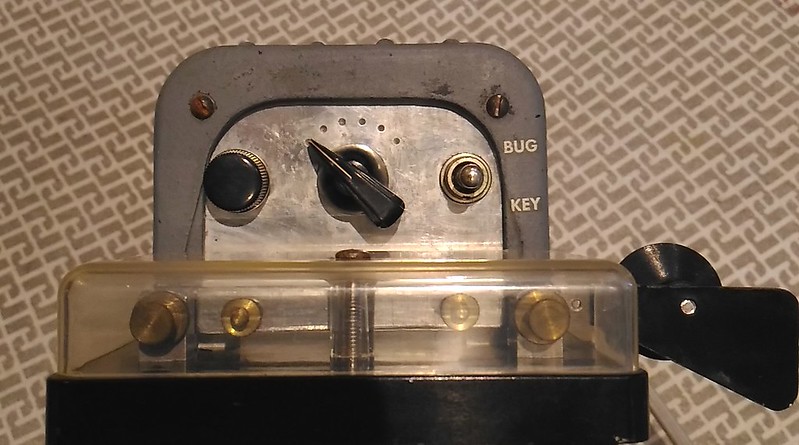
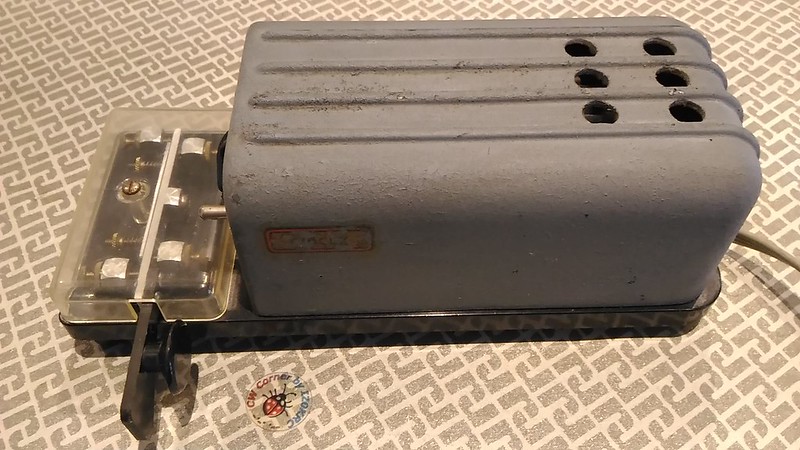
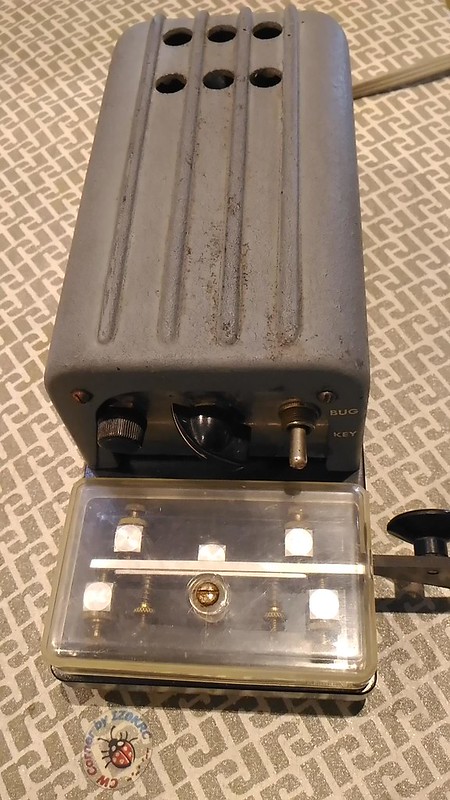
Con le foto postate sotto ho avuto l'occasione di vedere l'interno del paddle, sembra come nuovo ed apparentemente deve aver lavorato veramente poco. Il colore grigio è un colore non convenzionale, in quanto tutti gli altri visti in rete hanno il coperchio nero.
Sono convinto che il colore grigio è originale, in quanto sopra vi è ancora il logo del venditore e le scritte di switch BUG o KEY, segno che il keyer poteva simulare nell'azione l'uso del bug.
Il tasto era comunemente denominato tra i radioamatori Statunitensi, “la sedia elettrica”, per via delle scariche che si potevano prendere durante la trasmissione. La chiave aveva le sue parti metalliche a diretto contatto con i 110 v. motivo dell’aggiunta della copertura in plexiglass fornita con la chiave.
Qui un video interessante sul primo keyer elettronico al mondo.
14 Febbraio 2018
The Mon-Key was the first electronic key produced and marketed for amateur radio.
Manufactured from 1947 to 1958 by M.f.g. Electric Eye Equipment Co. of Danville, IL.
The Mon-Key was sold with a storage box containing the keyer, documents with detailed wiring diagrams and the user manual.
The telegraph set consisted of a single block, the electronics and mechanical paddle resting on a thick Bakelite base. The metal top covered the electronics, while the paddle was protected by a plexiglass cover. The keyer operated on a 110-120 volt mains voltage.
The Mon-Key did not use a transformer to step down the supply voltage, but rather used a resistive line cable.
The filament voltages of the three tubes were connected in series and used just under 60 volts; the remaining 50–60 volts were dissipated as heat by the resistive wire.
Resistive line cables were not uncommon at the time and were used even for the cheapest radio transmitters. The solution adopted for the Mon-Key not only reduced production costs but also avoided creating a much bulkier object with the addition of a heavy transformer.
This solution proved to be a double-edged sword over time. In fact, many of these sets today do not work precisely because of the weakness of the resistive wire. Various solutions have been adopted to solve this problem. One is to add a polarized capacitor in place of the wire in question, or a more complex solution is to replace the rectifier tube with a diode bridge rectifier and then a small 6 volt transformer to power the filaments of the remaining tubes.
Lynn Burlingame provides an excellent explanation for the recovery of this key at the following link: http://www.n7cfo.com/Tgph/MonKey.htm
For the occasion, I also purchased a 200-volt to 110-volt voltage reducer, but I haven't yet found the time, or rather, the energy, to test whether this Mon-key works or not.
With the photos posted below, I had the opportunity to see the inside of the paddle; it looks like new and apparently hasn't had much use. The gray color is unconventional, as all the others I've seen online have a black cover.
I'm convinced the gray color is original, as the seller's logo and the BUG or KEY switch markings are still visible, indicating that the keyer could simulate the use of the bug.
The key was commonly referred to among American radio amateurs as the "electric chair," due to the shocks one could receive during transmission. The key's metal parts were in direct contact with 110 volts, which is why the plexiglass cover provided with the key was added.
Here's an interesting video on the world's first electronic keyer.
 MON-KEY
 MON-KEY
 MON-KEY
 MON-KEY undercover wieu
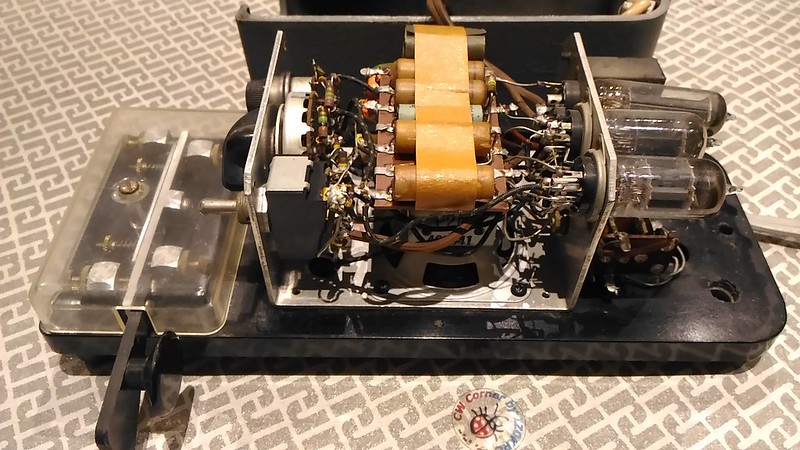 MON-KEY undercover wieu
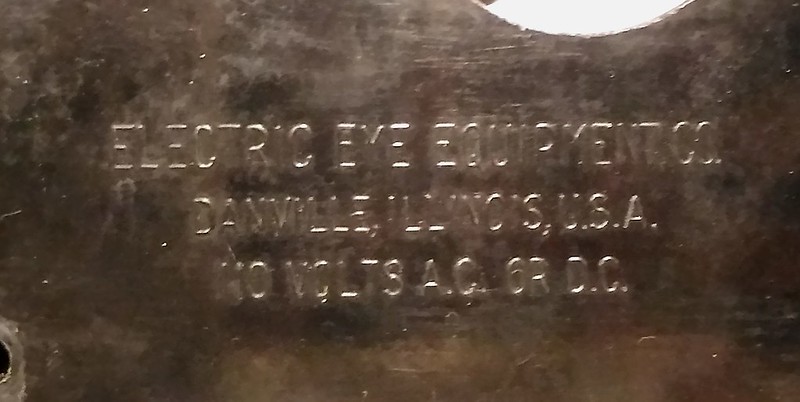 MON-KEY, underbase firma and write : "110 VOLTS A.C. OR D.C."
CODAX KEYER, by Waters Mfg.
KY.US.002
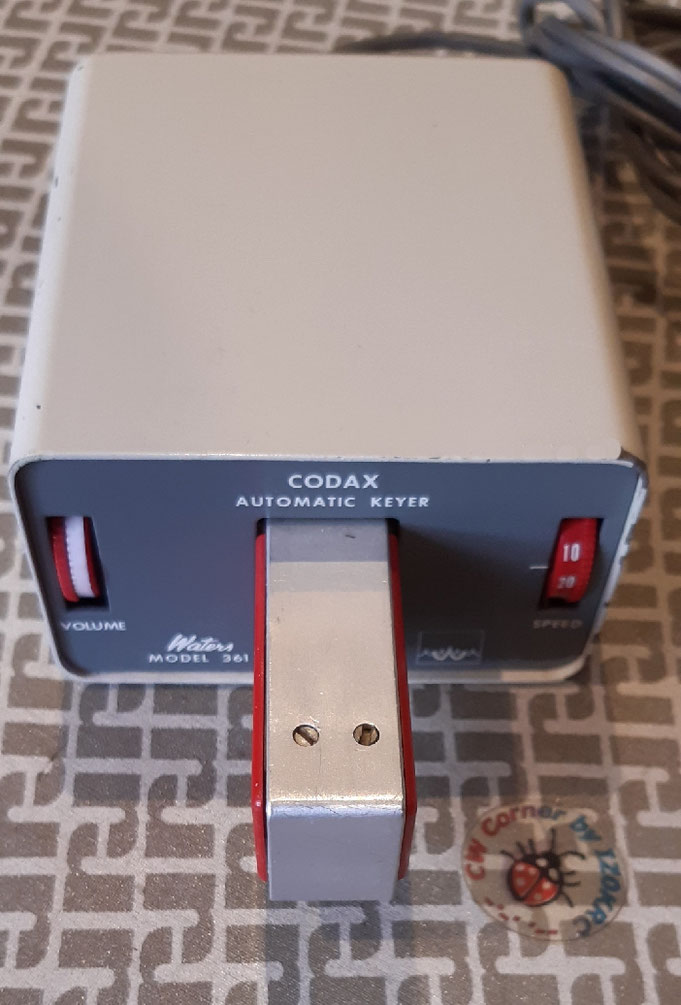
Keyer automatico Codax modello 361 costruito dalla società Waters Mfg inc. di Wayland nel Massachusetts.
Lo strumento lavora con con un rapporto punto linea di 3:1. Ha il controllo della velocità sul lato destro, mentre sul lato sinistro si può regolare il volume per ascoltare il codice emesso in direttamente in cuffia.
Lo strumento ha un alimentatore entrocontenuto che gli permette di essere alimentato direttamente dalla rete elettrica di casa.
Codax Model 361 automatic keyer manufactured by Waters Mfg Inc. of Wayland, Massachusetts.
The device operates with a 3:1 dot-to-dash ratio. It has a speed control on the right side, while the volume can be adjusted on the left side to listen to the code being emitted directly through headphones.
The device has a built-in power supply that allows it to be powered directly from the home electrical supply.

Pubblicità d'epoca dei prodotti Waters da magazine QRZCQ anno 1963
Vintage advertisement for Waters products from QRZCQ magazine, 1963
02 Maggio 2022.

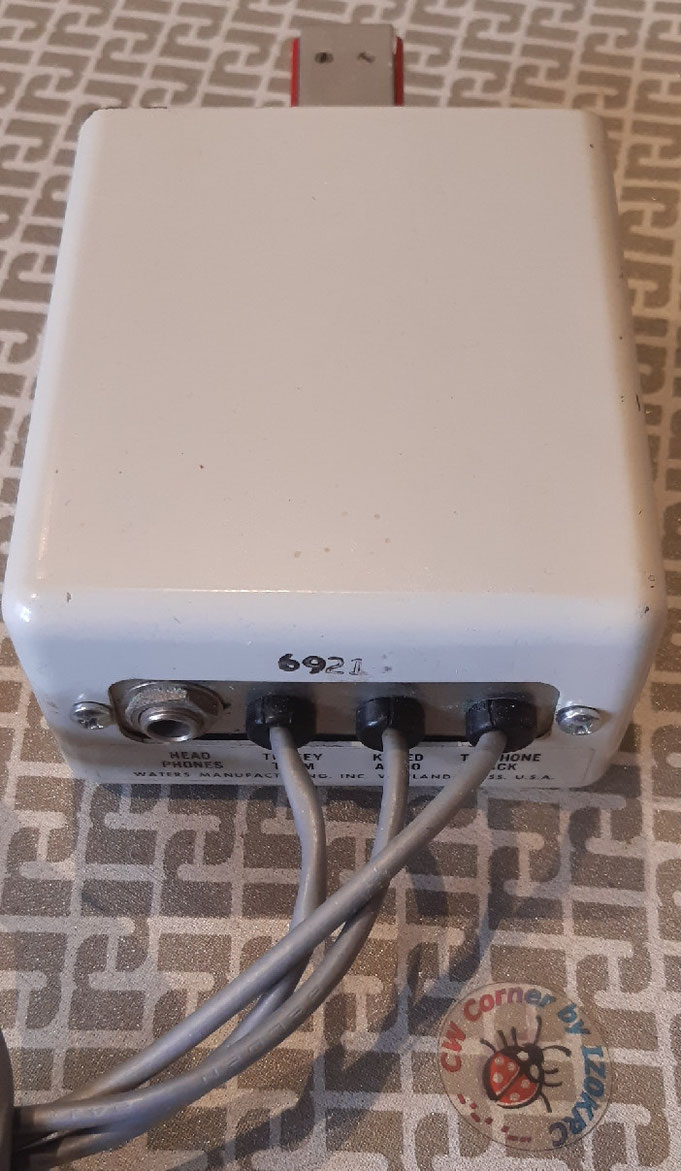
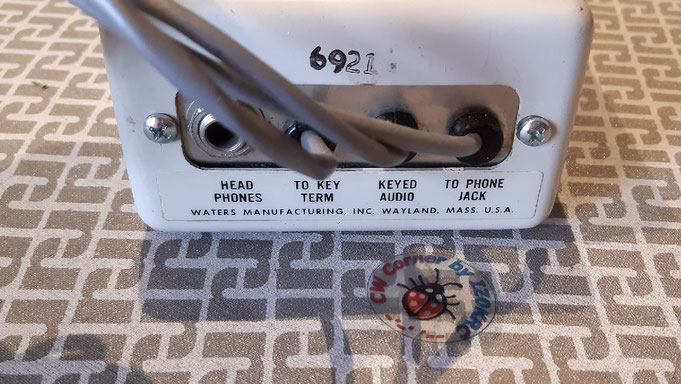
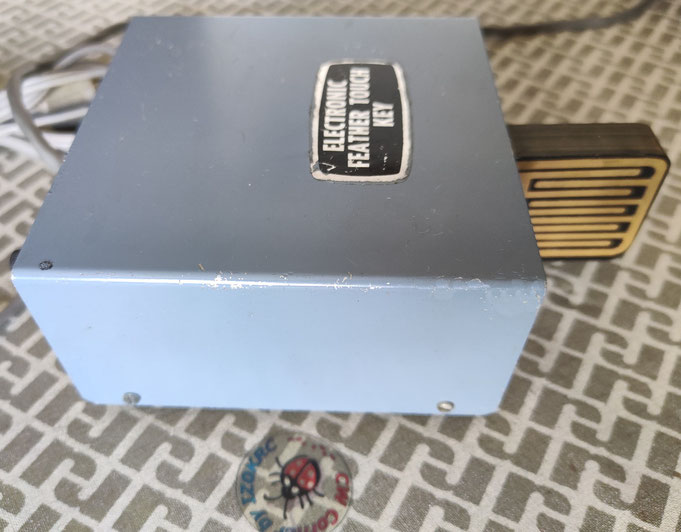
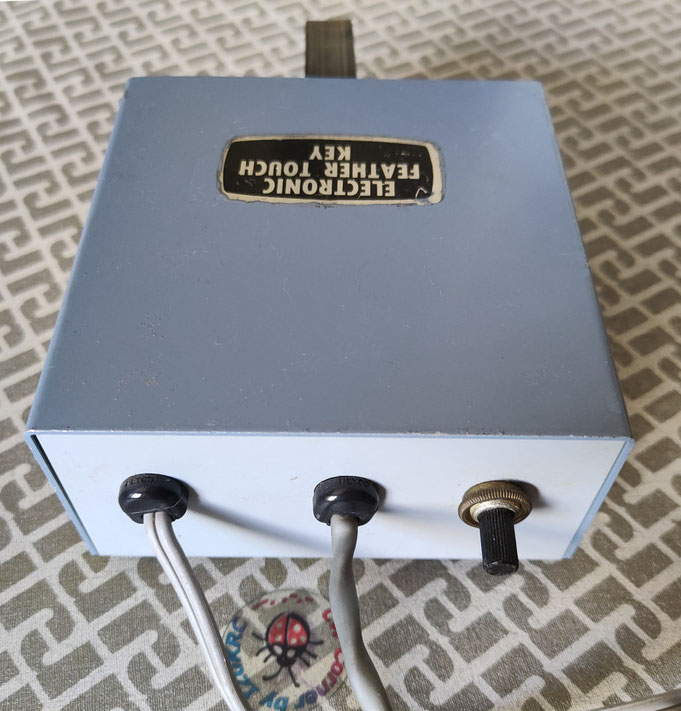
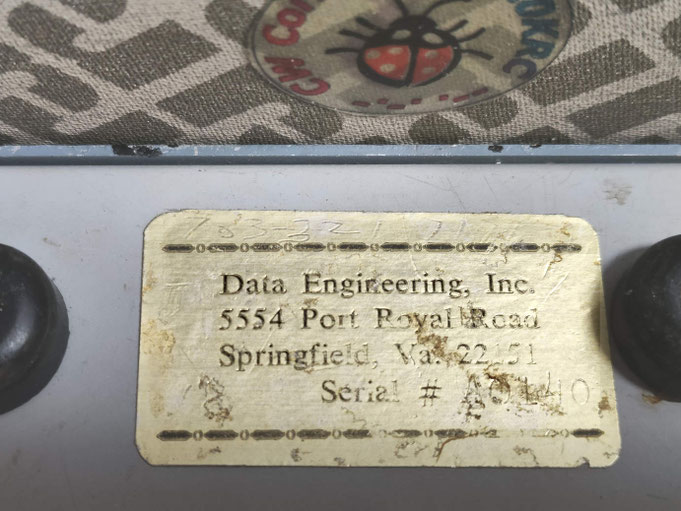
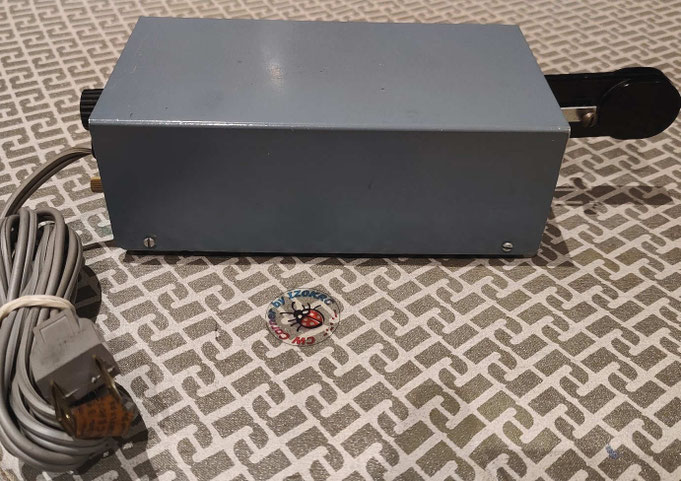
FEATHER TOUCH KEYER, by Data Engineering Inc.
KY.US.003
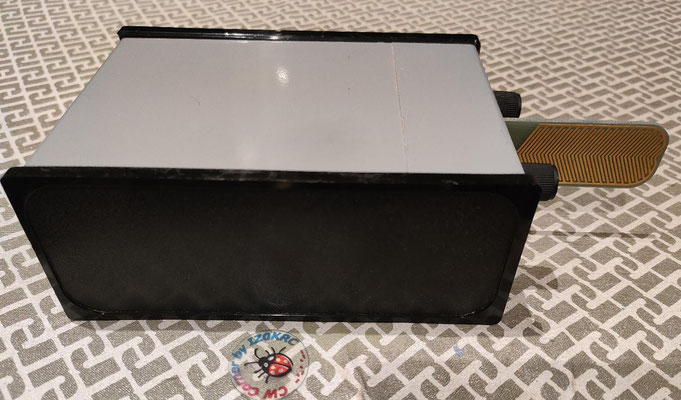
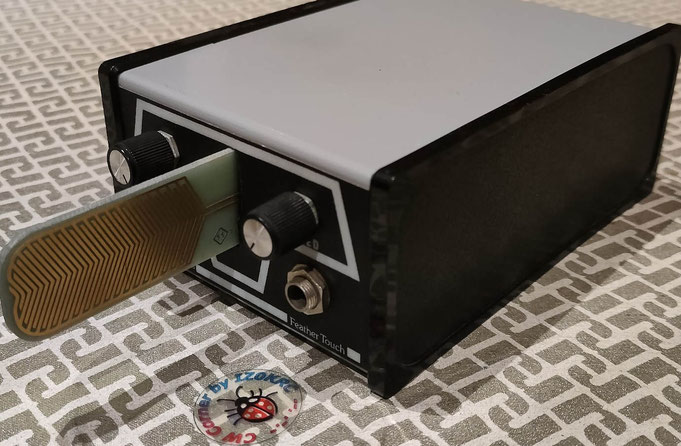
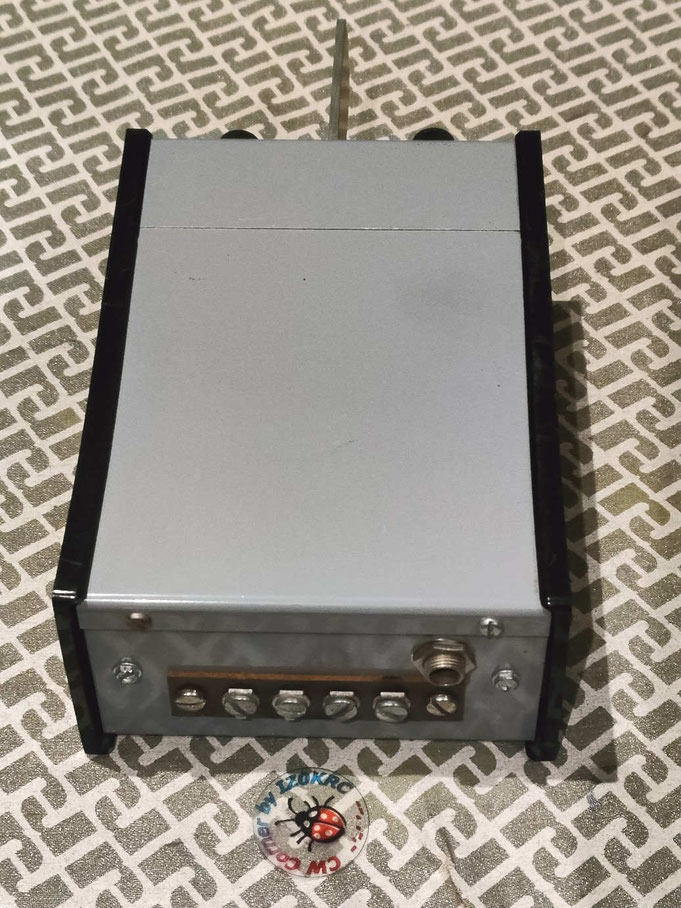
Uno dei primi keyer con elettronica a stato solido a funzionare senza il movimento delle parti.
Prodotto dalla Data Engineering inc. è entrato in commerico nel 1972, sono state prodotte due versioni, quello che segue è la prima versione. Può essere utilizzato come tasto a singola leva o tasto a doppia leva, mediante uno switch posto nella parte posteriore dello strumento. Mentre il secondo modello lo si vede dalla pubblicità d'epoca, sotto esposta, con i due tasti selettori posti sopra la coperchio.
L'alimentazione è diretta alla rete elettrica di casa, sul cavo di alimentazione ha un selettore per selezionare 100 o 250 Volts.
One of the first keyers with solid-state electronics to operate without moving parts.
Manufactured by Data Engineering Inc., it was released in 1972. Two versions were produced; the following is the first version. It can be used as a single-lever key or a double-lever key using a switch on the back of the instrument. The second model, shown in the vintage advertisement below, has two selector buttons on the top of the cover.
It is powered directly from the mains; the power cord has a selector switch for 100 or 250 volts.

Pubblicità dell'epoca del Feather tocuh keyer
Advertisement from the era of the Feather touch keyer
02 Maggio 2022.
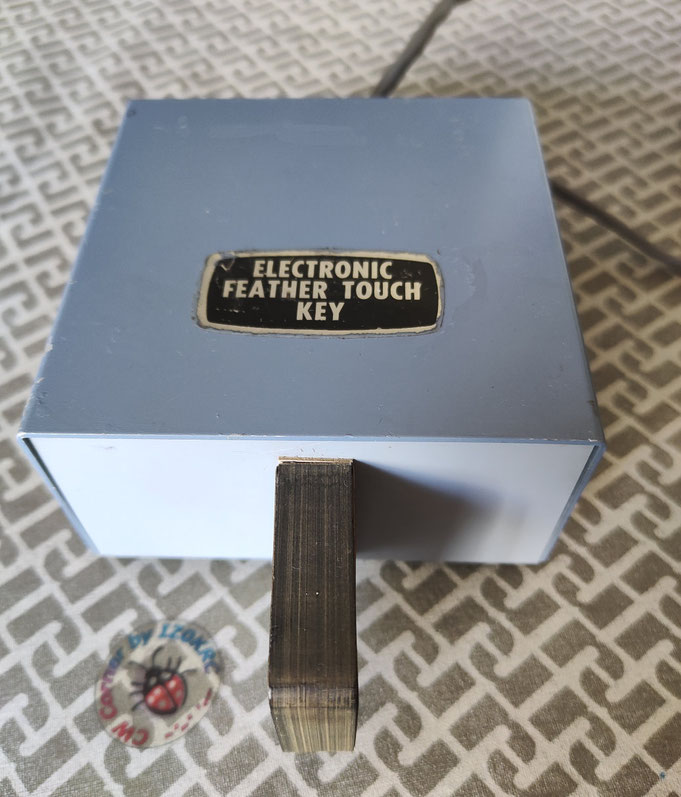
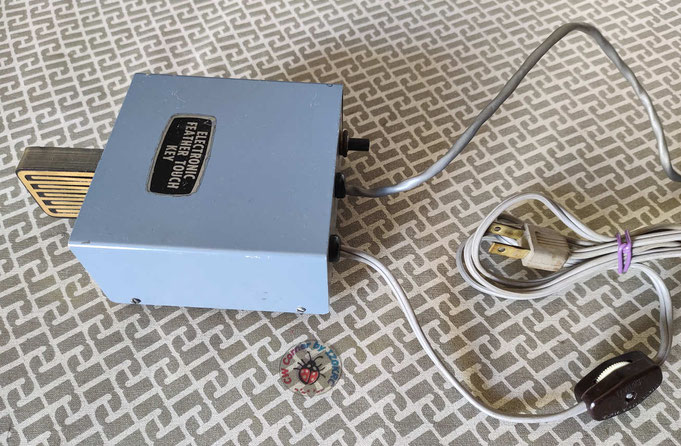
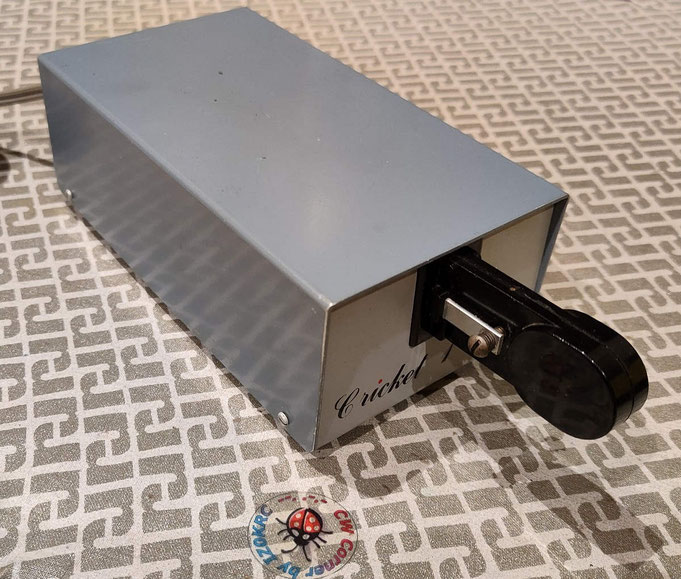
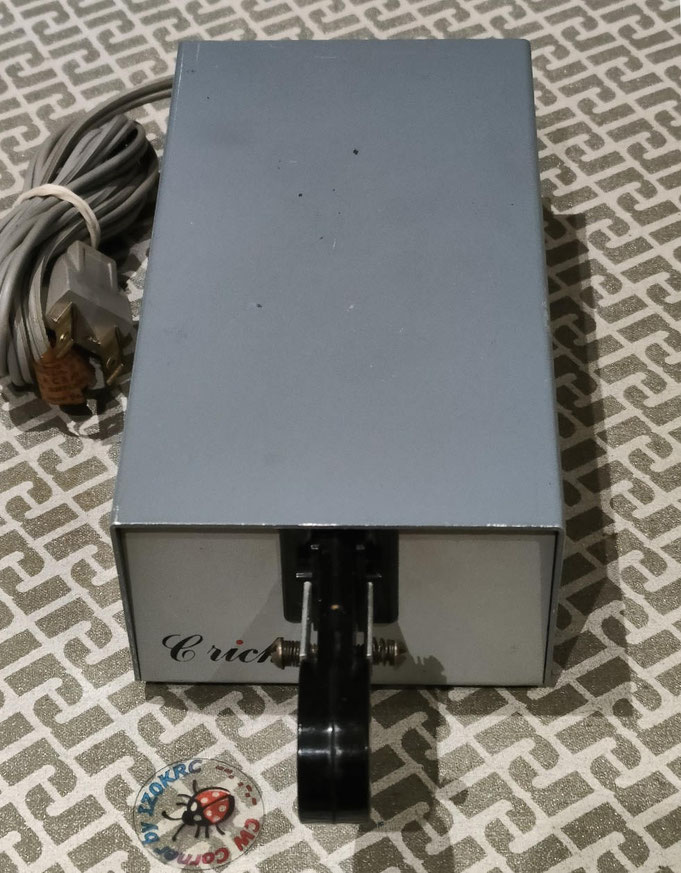
CRICKET KEYER.
KY.US.004
Keyer elettronico prodotto inizialmente dalla Data Engineering Inc. di Springfiled VA. come si nota nelle prime pubbilicità del 1973. Seguirà poi nella produzione dello stesso keyer un altra società, la Data Signal Inc. di Albany GA.
Electronic keyer initially produced by Data Engineering Inc. of Springfield, VA, as seen in the first advertisements in 1973. Another company, Data Signal Inc. of Albany, GA, later followed in the production of the same keyer.

Pubblicità rilevata su HAM Radio magazine edizione Ottobre 1973.
Advertisement found in HAM Radio magazine October 1973 edition.
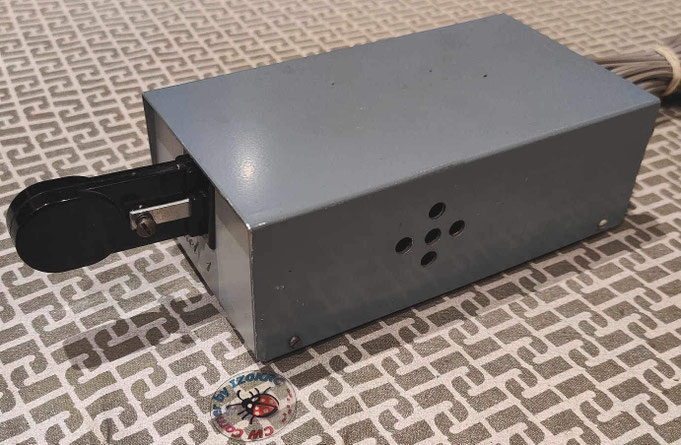
Sono state prodotte due versioni di questo keyer, il tasto sott oesposto è la prima versione , mentre l'immagine che segue mostra la seconda versione. Le differenze tra le due versioni sono veramente minime, cambia lo stile della scritta Ckriket I° e le viti due al fianco della leva di comando per determinare la corsa della stessa.

Cricket Key second version.
La manopola infatti si muove orizzontalmente a destra e sinistra, chiudendo dei piccoli contatti laterali che ne permettono la lettura da parte del circuito elettronico, per commutare il moviment oin punti e linee. Il Keywer lavora come leva singola, può lavorare emettendo punti e linee in automatico, oppure commutando da dietro il pannello un switch, può trasmettere anche in modo semiautomatico, come un bug. Sempre nel pannello posteriore ha un buon set di regolazioni, tra cui il peso la velcoitò, la notae il volume. Il keyer offre la possibilità di riascoltare il codice da un piccolo altoparlante interno, per allenamento o studio del codice morse. Non ha esternamente un selettore di voltaggio, ma può essere alimentato direttamente dalle rete elettrica di casa, o in alternativa in CC a 12 volts .
Two versions of this keyer were produced; the key shown below is the first version, while the image below shows the second version. The differences between the two versions are very minimal, except for the style of the Cricket Key I° lettering and the two screws next to the control lever that determine its travel.
The knob moves horizontally left and right, closing small lateral contacts that allow it to be read by the electronic circuit, switching the movement between dots and dashes. The Keyer works as a single lever and can output dots and dashes automatically, or by switching a switch from behind the panel. It can also transmit semi-automatically, like a bug. The rear panel also has a good set of adjustments, including weight, speed, pitch, and volume. The keyer offers the option of listening to the code through a small internal speaker, for training or studying Morse code. It does not have an external voltage selector, but can be powered directly from the home electrical network, or alternatively from 12 volt DC.

Pubblicità rilevata su 73 magazine edizione Marzo 1975.
Advertisement found in 73 magazine, March 1975 edition.
02 Maggio 2022.
FEATHER TOUCH KEYER, by Kantronics
KY.US.005
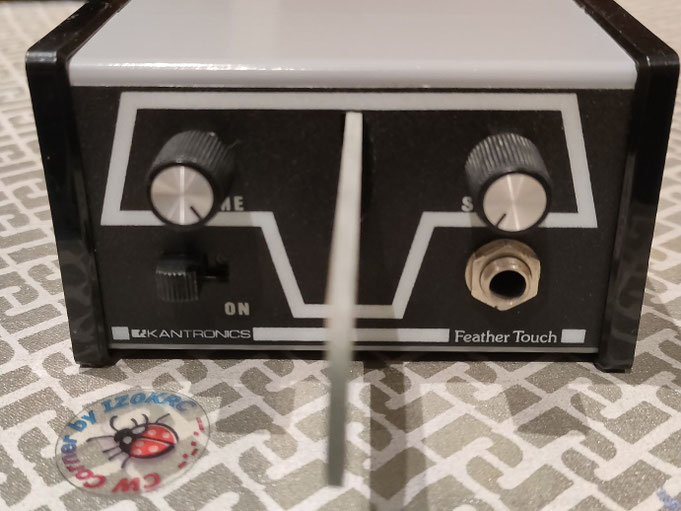
Un altro touch keyer elettronico prodotto Kantronics di Lawrence Kansas. prodotto dalla metà degli anni '70. Come enfatizza la pubbilicità, non spremere le palette, basta un tocco leggero per farlo operare.
Può essere utilizzato come tasto da esercitazione, ascoltando la propria trasmissione tramite le cuffie o trasmettere collegandolo direttamente alla radio. E' dodtato sul frontale di due manopole per la regolazione della velocità di trasmissione e del volume oer l'ascolto.
Al suo interno ha un allogiamento per delle batterie da 1,5 volts in modo da renderlo portatile.
Another electronic touch keyer made by Kantronics of Lawrence, Kansas, has been in production since the mid-1970s. As the ad emphasizes, don't press the paddles; a light touch is enough to operate it.
It can be used as a practice key, listening to your own broadcast through headphones, or transmitting by connecting it directly to the radio. It has two knobs on the front for adjusting the transmission speed and volume for listening.
It has a compartment for 1.5 volt batteries, making it portable.

Pubblicità apparsa su Cq magazine Aprile 1978.
Advertisement appeared in Cq magazine April 1978.
02 Maggio 2022.
OMEGA DA - Digital automatic keyer
KY.US.006
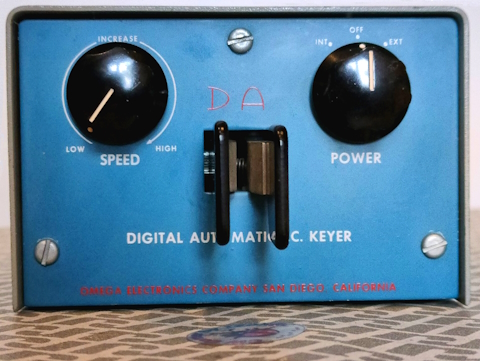
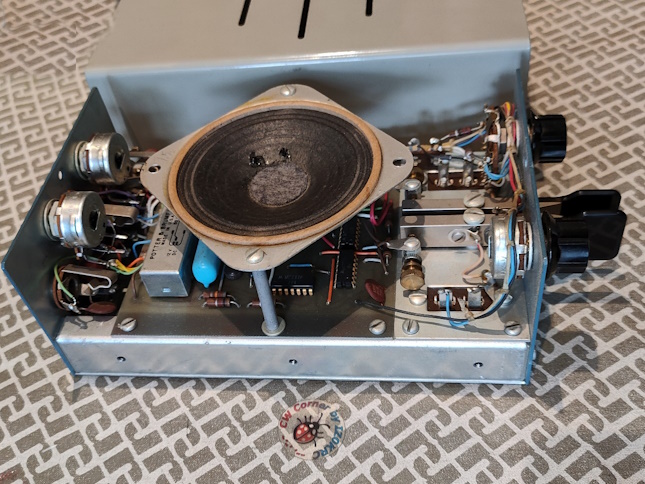
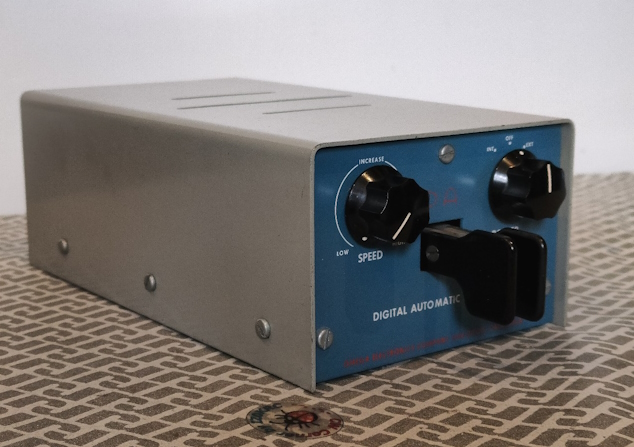
Un keyer americano prodotto dalla Omega Electronic Company di San Diego California.
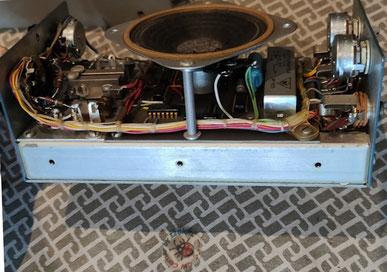
Dai materiali utilizzati e dall'elettronica interna mi fanno collocare la costruzione di questo Keyer intorno agli anni '70. Elettronica a integrati, altoparlanete entrocontenuto e slido struttura deicata al key entrocontenuto.
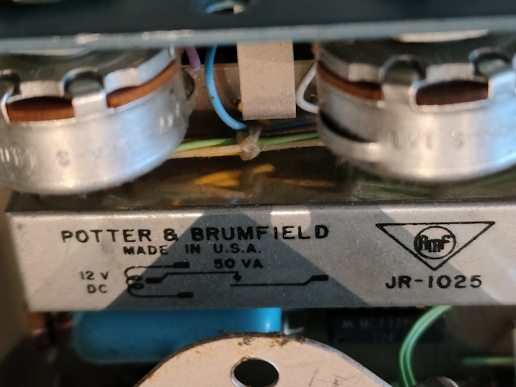
Al suo interno sono stati utilizzati solo componenti costruiti negli USA, ben evidente dalle foto è il relè reels costruito dalla società Potter & Brumfiled di Princenton Illinois.
Purtroppo non ci sono nel Net informazioni, foto od opuscoli che possono dare ulteriori informazioni su questo keyer. Ho trovato su QRZ.com all'interno della pagina di Andrew KA1GTT la foto di una Radio Omega operante nei gli 80 e 40 metri in CW, dove si può notare che lo stile dei pannelli frontali e posteriori sono simili a quelli el keyer.
se per caso avete utleriori informazioni su questa piccola produzione ve ne sarei grato.
Può essere utilizzato come tasto da esercitazione, ascoltando la propria trasmissione tramite le cuffie o trasmettere collegandolo direttamente alla radio. E' dodtato sul frontale di due manopole per la regolazione della velocità di trasmissione e del volume oer l'ascolto. L'alimentazione esterna era a 6 o 12 volts.
An American keyer manufactured by Omega Electronic Company of San Diego, California.
The materials used and the internal electronics suggest this keyer was built around the 1970s. It features integrated circuits, a built-in speaker, and a solid structure dedicated to the built-in keyer.
Only components made in the USA were used; clearly visible in the photos is the relay reel made by Potter & Brumfield of Princeton, Illinois.
Unfortunately, there is no information, photos, or brochures on the Internet that could provide further information about this keyer. I found a photo of an Omega radio operating on 80 and 40 meters in CW on QRZ.com, on Andrew KA1GTT's page, where you can see that the front and rear panels are similar in style to those of the keyer.
If you have any further information on this small production, I would be grateful.
It can be used as a practice button, listening to your own broadcast through headphones, or transmitting by connecting it directly to the radio. It has two knobs on the front for adjusting the transmission speed and volume for listening. The external power supply was 6 or 12 volts.
22 Ottobre 2022


Katsumi KEYER Globalman model EK 108D
KY.JP.001
Katsumi, nota casa elettronica Giapponese, ha prodotto molteplici keyer elettronici, il modello EK 108D è il primo modello prodotto, opera esattamente come un bug, con l'utilizzo dell'elettronica. Sul frontale ha due manopole per regolare velocità di trasmissione e suono per ascoltre il codice durante la trasmissione. Lo strumento poteva essere utilizzato con la radio o stand alone con il suo altoparlante per allenamento o apprendimento del codice morse.
Katsumi, a well-known Japanese electronics company, produced several electronic keyers. The EK 108D model was the first. It operates exactly like a bug, using electronics. On the front, it has two knobs for adjusting the transmission speed and the sound to listen to the code during transmission. The device could be used with the radio or standalone with its speaker for training or learning Morse code.
02 Maggio 2022.
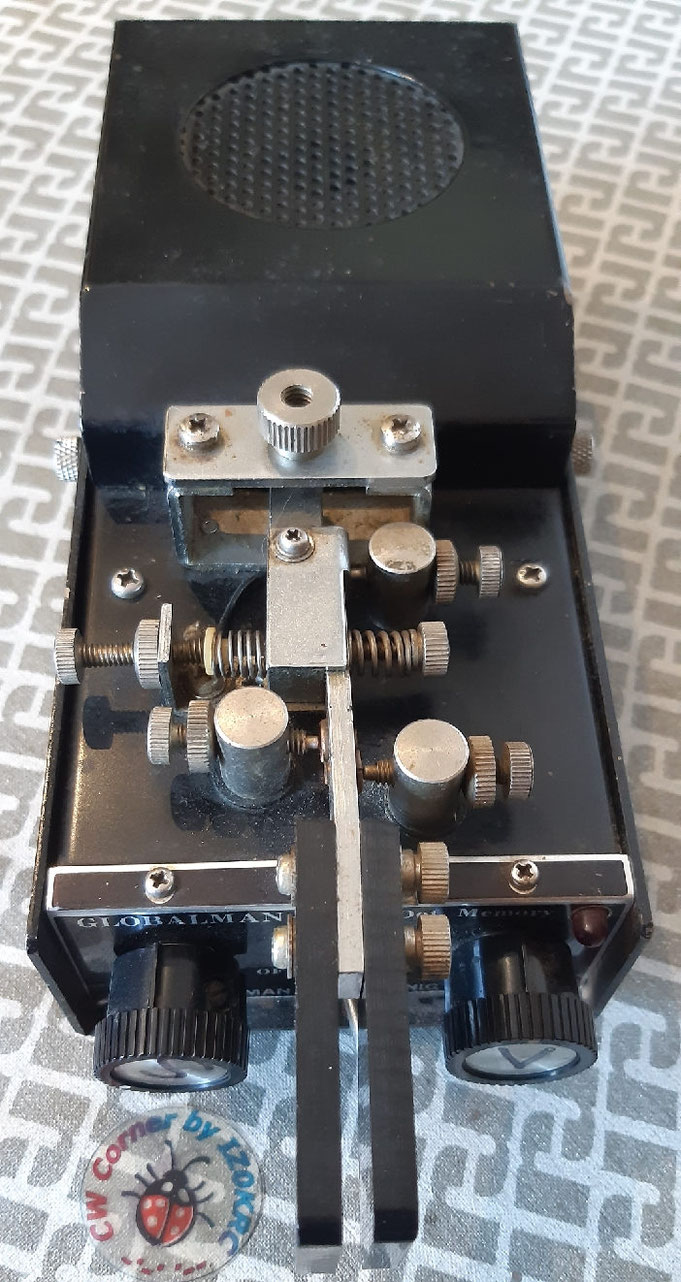
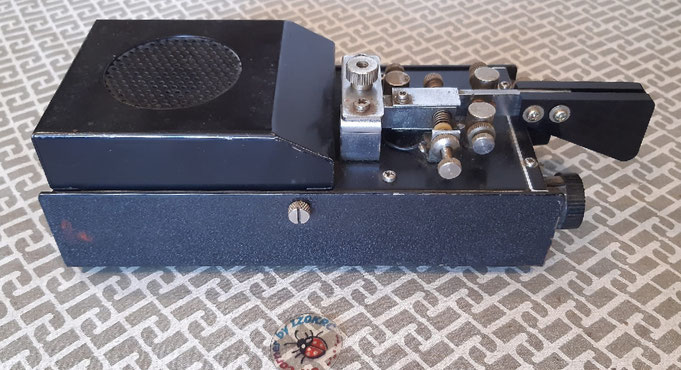
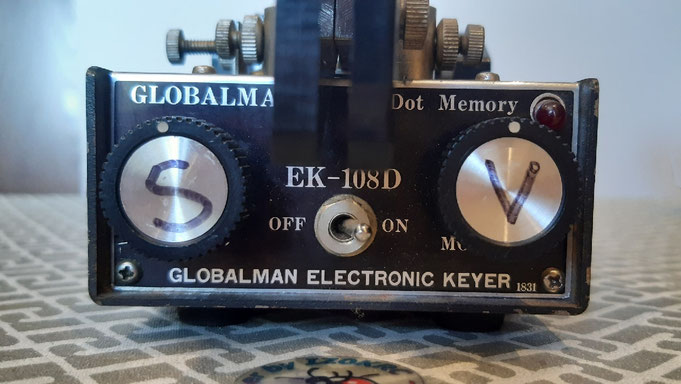

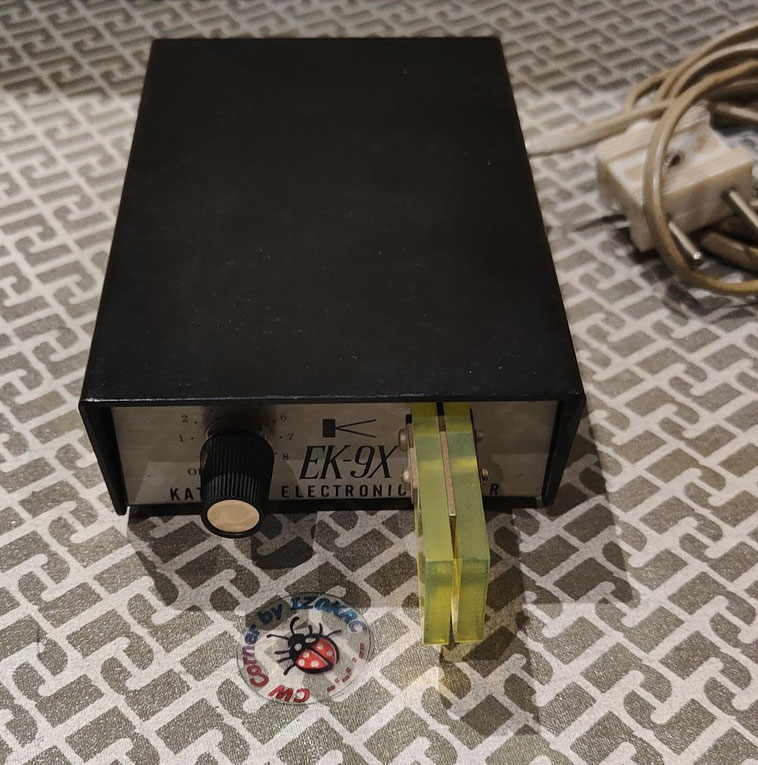
Katsumi KEYER Globalman model EK - 9X
KY.JP.002
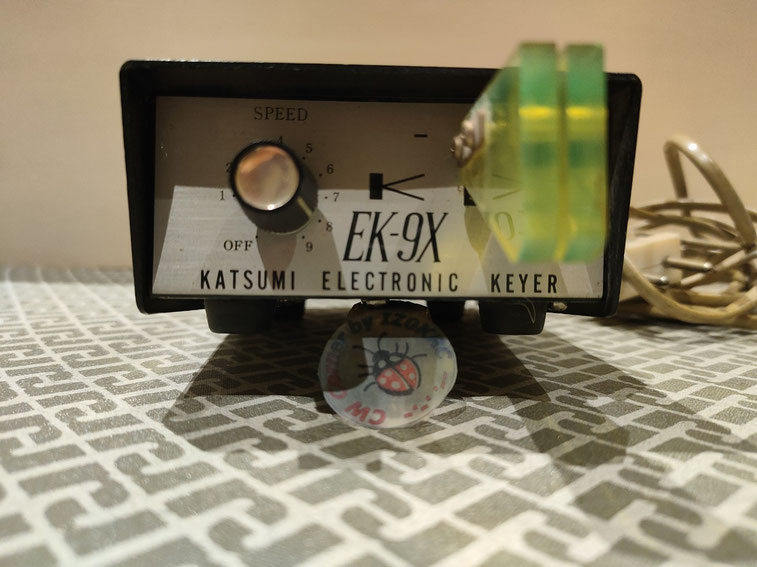
Altro keyer Giapponese prodotto dalla ditta Katsumi (vedi note nel keyer EK-108D.
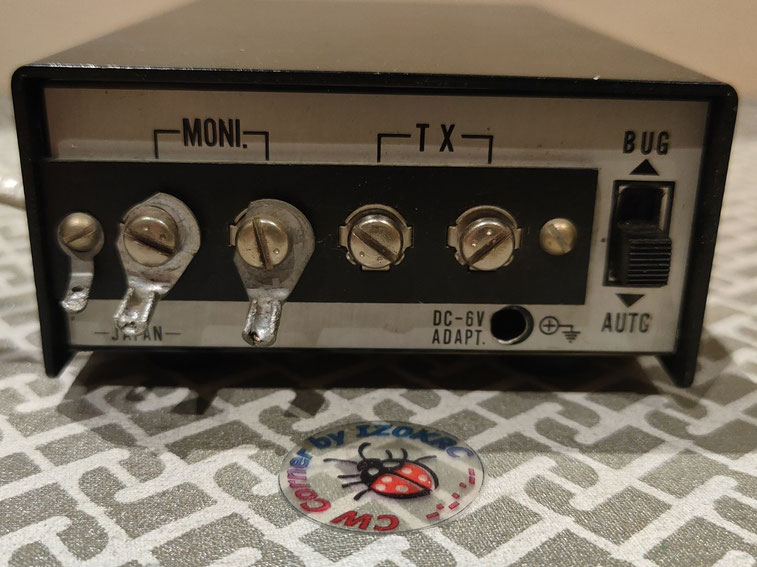
Un dei keyer elettronici a stato solido "della prima ora". PEr questo motivo la Katasmui ha permesso l'uso di questo keyer in due modalità. Tramite un *selettore posto dietro al keyer, si può scegliere il funzionamento "SEMI" per emulare l'uso seiautmomatico, al pari di un BUG, un utile espediente per introdurre l'elettronica anche chi era abiutato a trasmettere con un tasto semiautomatico, mentre selezionando "AUTO" si passava a una trasmissioen completamente automatica al pari dei moderni Keyer.
La trasmissione della manipolazione dal keyer alalradio avviene per il tramite di un relè, per funzionare con qualsiasi tipo di linea di trasmissione, inclusa la trasmissione a catodo (per le radio a valvole).
Funziona senza problemi per quello che è. Non è particolarmente sofisticato, dimostra però i progressi compiuti dai giapponesi in termini di evoluzioone elettronica già dagli inizi degli anni '60.
Sul frontale del keyer è presente la scritta EK-9X KATSUMI ELECTRONIC KEYER, sul alto sinsitro del pannello frontale vi è un selettore di velocità con regolazione da 1 a 9, sul lato destro del pannello frontale ci sono le due palette per la manipolazione. Sul retro del keyer ci sono i jack con le scritte MONI (per ascolto in cuffia) e TX (verso la radio) con interruttore BUG AUTO. Sul lato sinistro è presente la scritta JAPAN e sul lato destro DC-6V ADAPT. *Il selettore BUG AUTO definsice la modalità di utlizzo, come sopra indicato.
Sotto la base ci sono delle sigle, leggo 72, potrebbe essere l'anno di costruzione di questo keyer.
Al suo interno, sotto al coperchio c'è attaccato lo schema elettronico, mentre sul piatt odi base c'è ovviamente l'elettronica, la parte meccanica delle palette per la manipolazione e in fondo vicino ai contatti posteriori vi è l'alloggiamnerto per batterie tipo AAA.
Il mio focus principale, non è solo collezionare a catalogare strumenti telegrafici, quando possibile cerco se,pre di conoscere il "vissuto" di ogni cosa che riesco a trovare. Quando questo succede, è la mia più grande soddisfazione. Trovare la storia di un oggetto è per me restituire a loro un anima. In questo caso la fortuna mi ha permesso di aggiungere a questo keyer non solo la storia della produzione, ma anche il suo vissuto.
Questo keyer è appartenuto a Jan Ellen (1924-2006) il suo HAM call era PA0WSD, Jan è stato uno storico telegrafista di bordo della compagnia aerea KLM. Il suo nominativo è documentato sia nei registri dei radioamatori olandesi sia negli archivi storici dei telegrafisti KLM. Ho avuto la fortuna di riceverlo da sua figlia Paula, che mi ha scritto alcuni ricordi su suo padre :
[Il suo nominativo era PAOWSD.
Mio padre era telegrafista e navigatore della compagnia aerea KLM. Quindi la sua professione divenne in seguito il suo grande hobby. Insieme ad alcuni ex colleghi, avevano un club che, oltre a stare a casa, si recava ogni domenica al vecchio aeroporto di Schiphol per "lavorare" lì ].
La Stazione radio club di Schiphol PA0SNY/AM, è sita dentro l'omonimo aeroporto, zona est hangar 12.
PS. Non sono riuscito a trovare alcun manuale d'uso in rete, se qualcuno per caso lo ha, gli sarei grato se mi contatta per averlo. Grazie.
Another Japanese keyer produced by Katsumi (see notes on the EK-108D keyer).
One of the first solid-state electronic keyers. For this reason, Katsumi allowed this keyer to be used in two modes. Using a selector switch on the back of the keyer, you can select "SEMI" operation to emulate semi-automatic use, similar to a BUG, a useful way to introduce electronics even to those accustomed to transmitting with a semi-automatic key. Selecting "AUTO" switched to fully automatic transmission, similar to modern keyers.
Keying is transmitted from the keyer to the radio via a relay, so it can work with any type of transmission line, including cathode transmission (for tube radios).
It works flawlessly for what it is. It's not particularly sophisticated, but it demonstrates the progress the Japanese had made in terms of electronics since the early 1970s. '60.
The front of the keyer reads EK-9X KATSUMI ELECTRONIC KEYER. On the top left of the front panel is a speed selector with settings from 1 to 9. On the right side of the front panel are the two paddles for keying. On the back of the keyer are the jacks labeled MONI (for listening with headphones) and TX (for the radio) with a BUG AUTO switch. On the left side is the word JAPAN and on the right side is DC-6V ADAPT. *The BUG AUTO selector defines the operating mode, as indicated above.
Under the base are some abbreviations; I read 72, which could be the year of manufacture of this keyer.
Inside, under the cover, is the electronics schematic, while on the base plate are obviously the electronics, the mechanical part of the paddles for keying, and at the bottom, near the rear contacts, is the battery compartment. AAA.
My main focus is not just collecting and cataloging telegraph instruments; whenever possible, I try to understand the "history" of everything I find. When this happens, it's my greatest satisfaction. Finding the history of an object is, for me, giving it a soul. In this case, fortune allowed me to add to this keyer not only the history of its production, but also its history.
This keyer belonged to Jan Ellen (1924-2006). His HAM call was PA0WSD. Jan was a historic on-board telegrapher for KLM. His callsign is documented in both the Dutch amateur radio registers and the historical archives of KLM telegraphers. I was fortunate enough to receive it from his daughter, Paula, who wrote me some memories of her father:
[His callsign was PAOWSD.
My father was a telegraph operator and navigator for KLM Airlines. His profession later became his great hobby. Together with some former colleagues, they had a club that, in addition to staying at home, went every Sunday to the old Schiphol Airport to "work" there.] The Schiphol Club Radio Station PA0SNY/AM is located inside the airport of the same name, in the eastern area of hangar 12.
PS. I couldn't find any user manual online. If anyone happens to have one, I'd appreciate it if they could contact me to get it.
Thanks.
14 Giugno 2026

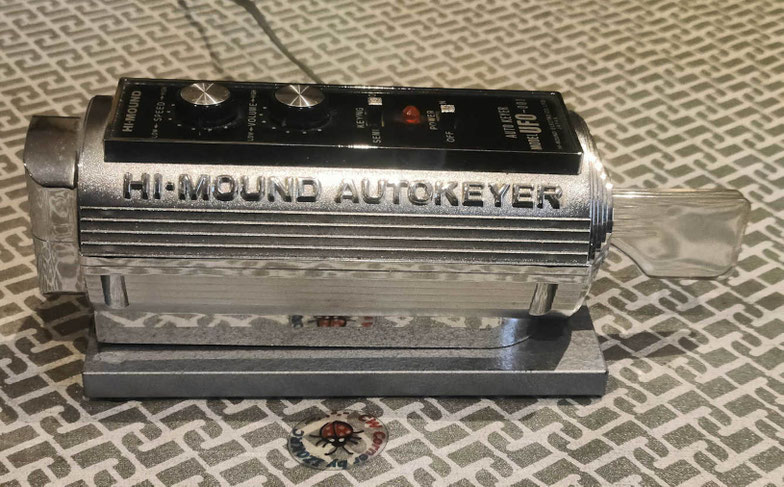
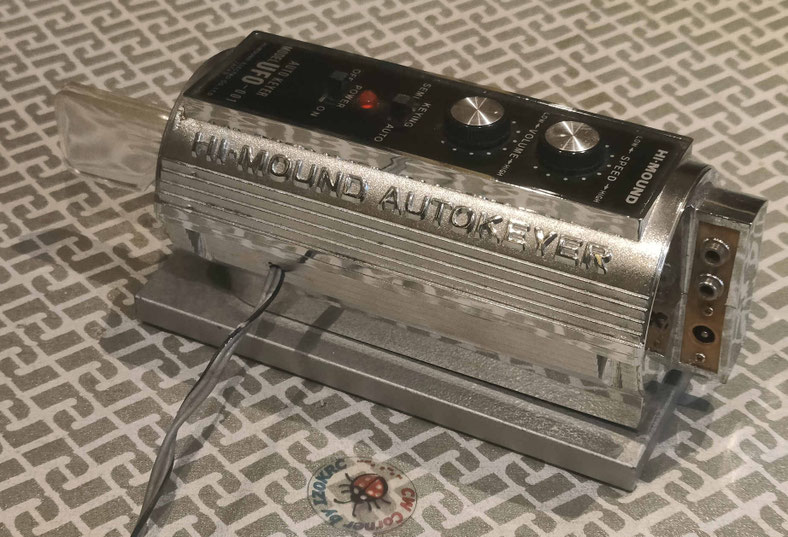
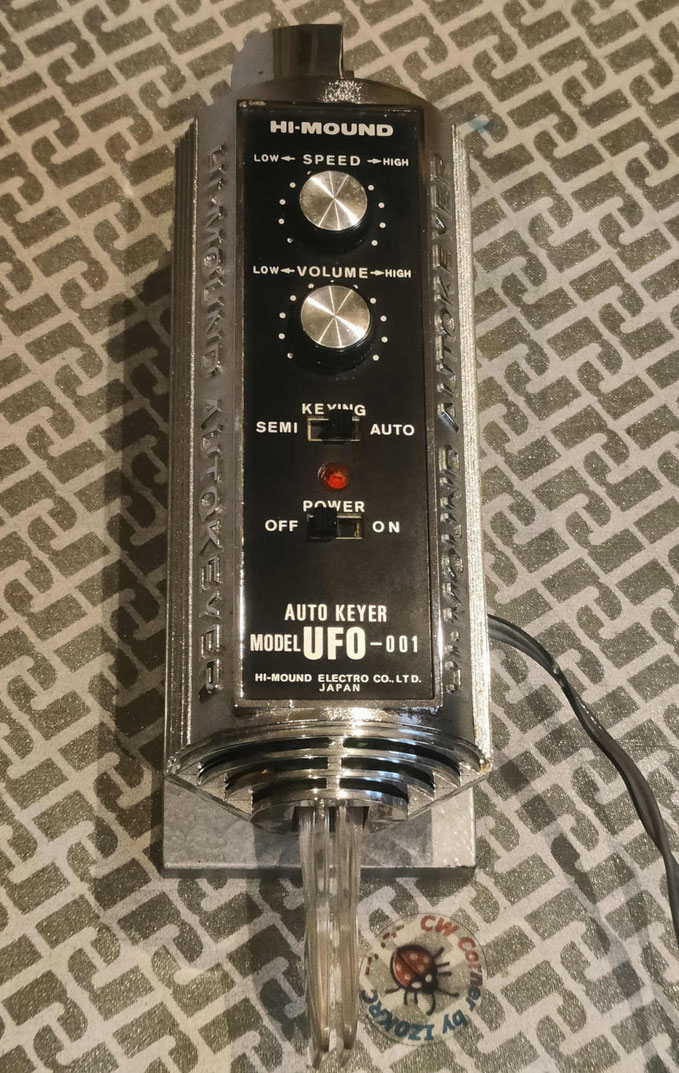
Coming soon, Japanese Ufo Keyer
KY.JP.002
Keyer elettronic costruito dalla Giapponese HI Mound from 1970's


EKM-3B
KY.SU.001
Tasto elettronico russo modello EKM-3b prodotto intorno ai primi anni '60 dalla Technomarin, ex Isitituto della Marina di San Pietroburgo, per uso navale.
Russian electronic key model EKM-3b produced around the early 1960s by Technomarin, formerly the Naval Institute of St. Petersburg, for naval use.

Il tasto solitamente lo avevo osservato sempre "libero", cioè asportato dal set telegrafico, come quello nell'immagine sopra.
Il sideswiper entro contenuto è di fattura superba, inoltre ha un utile sistema di regolazione posto proprio verso l'operatore, che ne permette di modificare velocemetne la rigidità del tasto.
Degno di nota è il proceso di ceratura di tutti i componenti elettronici per preservarli nel tempo dall'aggressione della salsedine.
I usually always observed the key "free," meaning removed from the telegraph set, like the one in the image above.
The sideswiper included is superbly crafted and has a useful adjustment system located right next to the operator, allowing for quick adjustment of the key's firmness.
Noteworthy is the waxing process of all the electronic components to protect them from salt water over time.
25 Novemre 2022
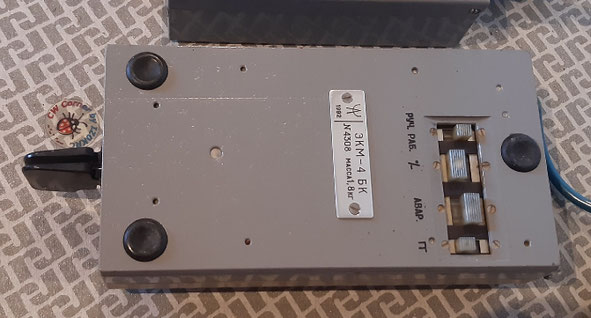
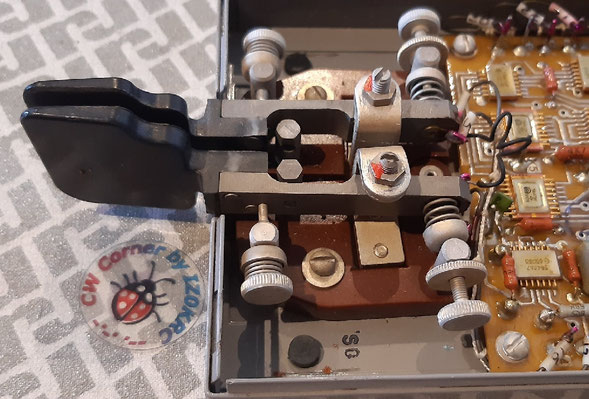
EKM-4
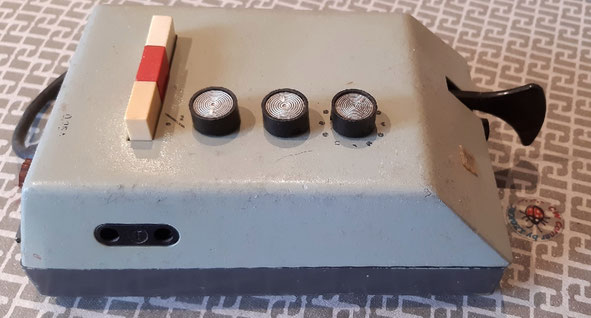
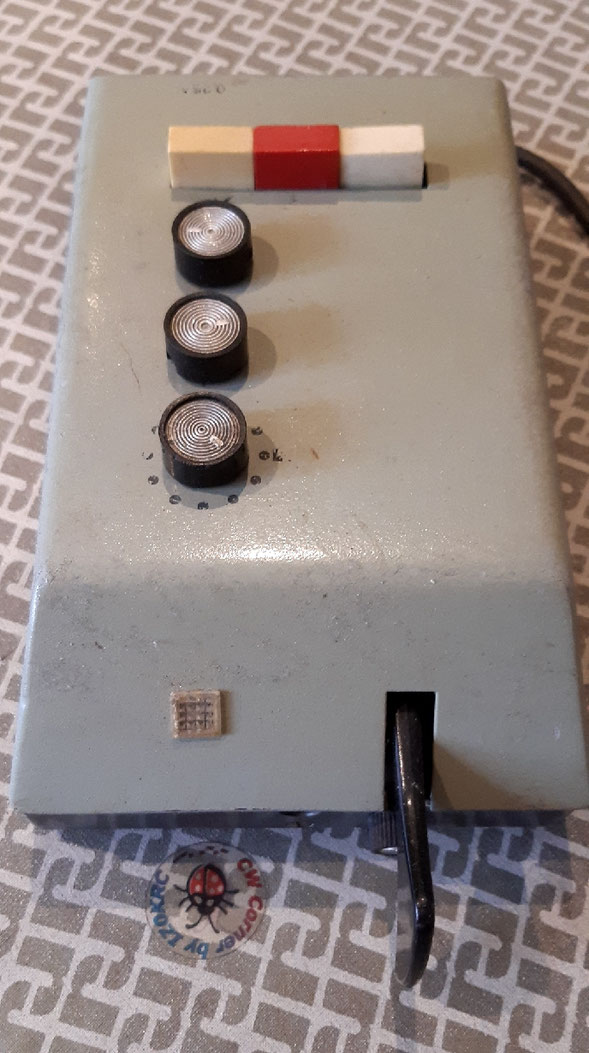
KY.SU.002
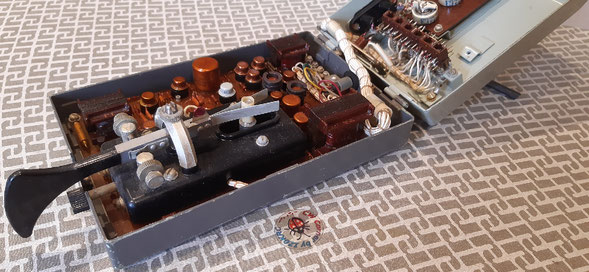
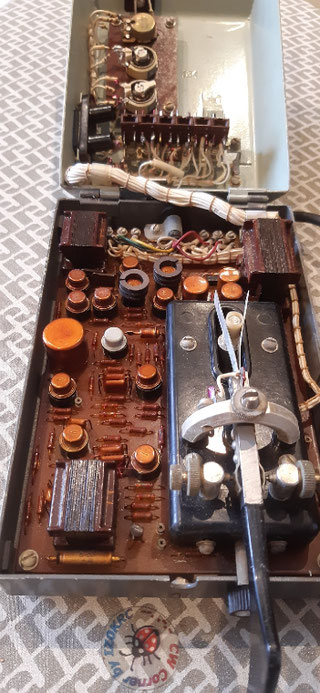
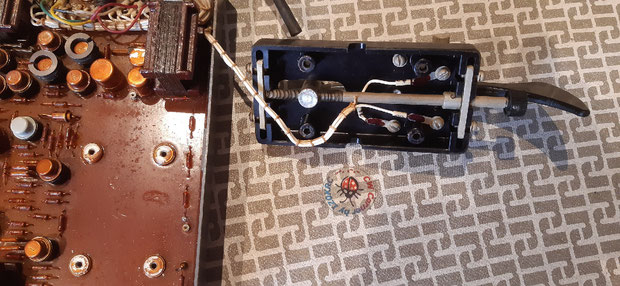
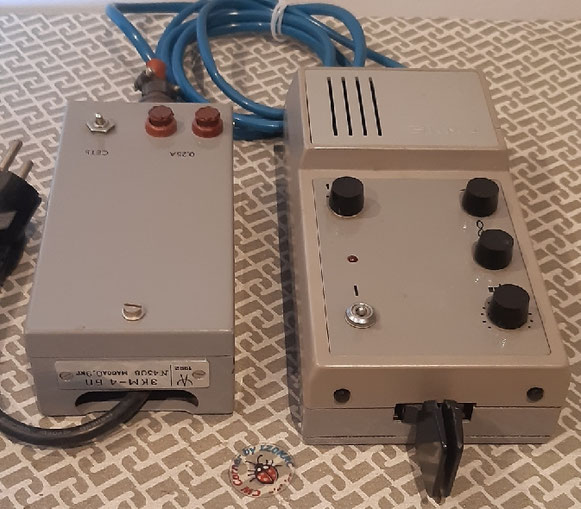
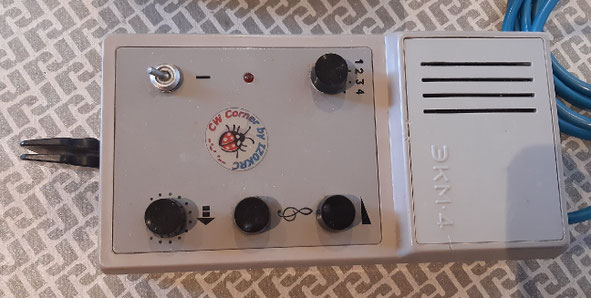
Tasto elettronico russo modello EKM-4 sviluppato e prodotto nei primi anni '80 presso la Tecknomarin di San Pietroburgo. I tasti erano destinati per l'uso su navi e centri radio costieri.
L'eccellente affidabilità e le svariate funzioni, unite alla buona meccanica (che permetteva di modificare la distanza tra le due palette) furono i fattori che decretarono all'epoca il success odi questo modello di paddle elettronico, diventato popolarie tra gli operatori delle stazioni costiere, e tra gli operatori navali, nonchè dei radioamatori.
Anche il paddle elettronico EKM-4 presenta la ceratura di tutti i componenti elettronici, al pari del suo predecessore EKM-3b.
The Russian EKM-4 electronic paddle switch was developed and manufactured in the early 1980s by Technomarin in St. Petersburg. The switches were intended for use on ships and coastal radio stations.
The excellent reliability and extensive functionality, combined with the robust mechanics (which allowed the spacing between the two paddles to be adjusted), were the factors that made this electronic paddle switch a success at the time. It became popular among coastal station operators, naval operators, and amateur radio operators.
The EKM-4 electronic paddle switch also features wax coating on all electronic components, like its predecessor, the EKM-3b.
26 Novemre 2022

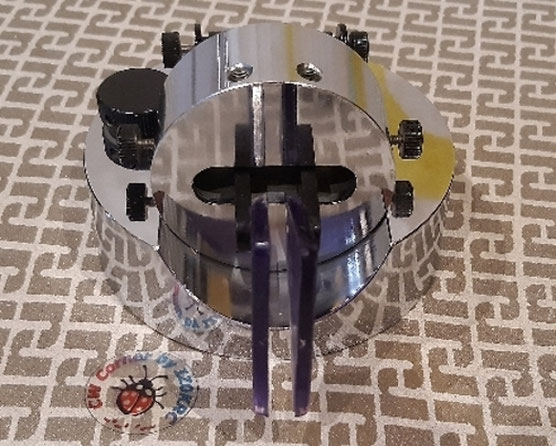
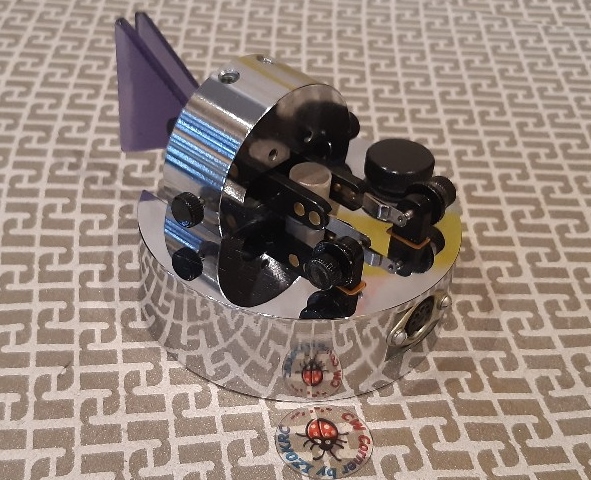
CCCP Key-8 - Electroinstrument
KY.RU.003
ElectroInstrument
"Key-8" Paddle with built in an electronic keyer!
Questo paddle è un superbo esempio dell'ingegneria sovietica.
Bello per via della sua finitura a specchio e un piacere da usare per svariati motiv.
Il paddle è stato produtto dalla ElectroInstrument di Voronezh, Russia (URSS ex Unione Sovietica).
ElectroInstrument era una ditta che operava per la produzione militare sovietica, specializzato in apparecchiature aerospaziali ed elettroniche.
La ditta è sopravvissuta alla ristrutturazione dell'URSS, ora produce televisori e vari prodotti elettronici di consumo.
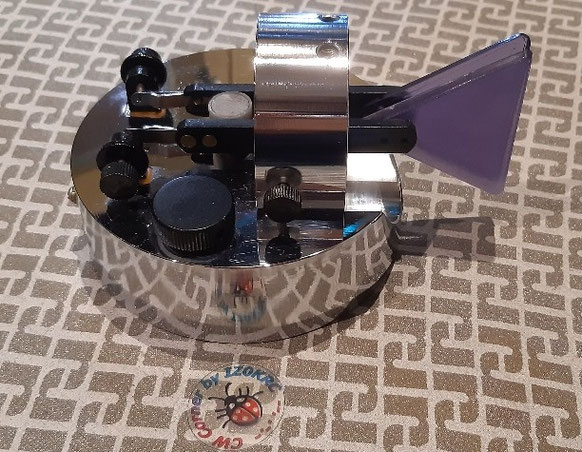
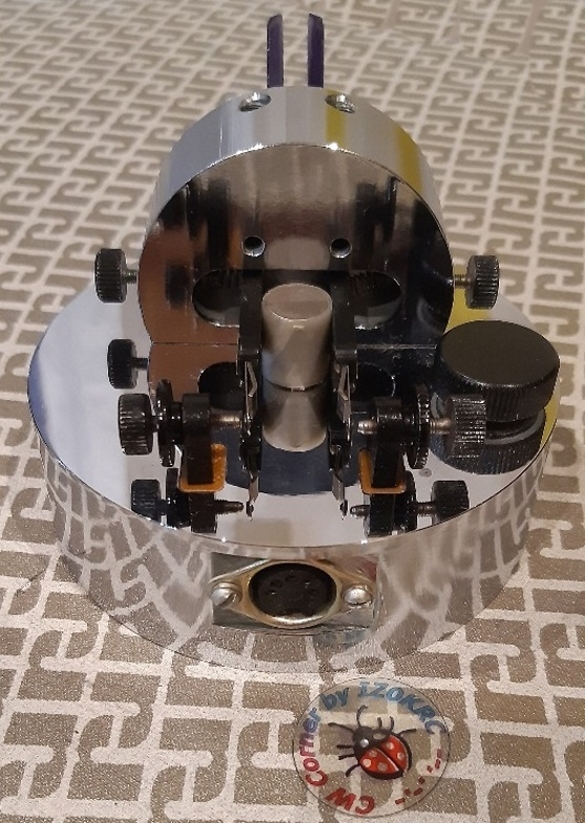
La prima cosa che noti del Key-8 è lo stile unico e massiccio ed il taglio lineare delle sue palette.
La base è ricavata da un solido blocco di ottone e rifinita con cromo a specchio, misura 4" di diametro e 3/8" di spessore raggiungendo un peso considerevole di circa 3,5 kg. La base al al suo interno custodita la sua anima elettronica, il keyer.
Le viti, i controdadi e la manopola di regolazione della velocità sono tutti in ottone lavorato, laccato nero. I bracci della paletta e le aste di contatto sono in acciaio, di nuovo laccato nero.
La tensione e la spaziatura delle palette sono regolabili in modo indipendente, l'azione del paddle è fluida e precisa.
I contatti sono in argento.
Il keyer elettronico entro contenuto non è jambico, ovvero schiacciando entrambi i paddle si otterrà una stringa di dits o dah, non alternando dits e dah Vi sono però le istruzioni per bypassare il keyer interno e usare il paddle con un keyer esterno.
Il keyer è un interessante esempio di elettronica tardo-sovietica, con alcuni circuiti integrati e componenti dall'aspetto non molto comune.
Il keyer richiede una tensione compresa tra 6 e 15 V. in C.continua.
Un oscillatore di tono è incluso e la velocità è impostata da una manopola nera posta sulla parte superiore della base.
La gamma di regolazione della velocità va da 5 a 50 WPM.
La codifica dell'uscita avviene tramite un relè metallico filettato interno alla base, quindi la linea della chiave è isolata elettricamente dal keyer, questo elimina i problemi di polarizzazione nell'alimentazione del paddle.
Tutti i collegamenti al keyer avvengono tramite una presa DIN a 5 pin posta sul retro della base (sotto vi sono delle istruzioni per il cablaggio della porta DIN a 5 pin).
Alcuni dati estratti dalle istruzioni/impostazione di regolazione del Key-8, specifiche tecniche:
Rapporto punto / tratto 1: 3
Rapporto punto / spazio 1: 1
Intervallo di velocità (WPM) 5-50
Alimentazione da +6 a + 15VDC
Frequenza Sidetone 850Hz (+/- 250)
Corrente di funzionamento 50mA max
Peso 1,3 kg (3 libbre 6,5 once)
Il tasto è stato venduto sino al 2012, tramite Morse express al costo di 139,95 $ + S.h.
ElectroInstrument
"Key-8" Paddle with a built-in electronic keyer!
This paddle is a superb example of Soviet engineering.
Beautiful with its mirror-like finish, it's a pleasure to use for a variety of reasons.
The paddle was manufactured by ElectroInstrument of Voronezh, Russia (formerly the USSR).
ElectroInstrument was a Soviet military production company specializing in aerospace and electronics equipment.
The company survived the restructuring of the USSR and now produces televisions and various consumer electronics.
The first thing you notice about the Key-8 is the unique, massive style and linear cut of its paddles.
The base is carved from a solid block of brass and finished in mirror-like chrome. It measures 4" in diameter and 3/8" thick, weighing a considerable 3.5 kg. Inside the base is the electronic heart of the paddle, the keyer.
The screws, locknuts, and speed control knob are all machined brass, lacquered black. The paddle arms and contact rods are steel, again lacquered black.
The paddle tension and spacing are independently adjustable, and the paddle action is smooth and precise.
The contacts are silver.
The built-in electronic keyer is not jammy, meaning that pressing both paddles will produce a string of dits or dahs, not alternating dits and dahs. However, instructions are provided for bypassing the internal keyer and using the paddle with an external keyer.
The keyer is an interesting example of late-Soviet electronics, featuring some uncommon-looking integrated circuits and components.
The keyer requires a voltage between 6 and 15 volts of DC.
A pitch oscillator is included, and the speed is set by a black knob on the top of the base.
The speed adjustment range is from 5 to 50 WPM.
Output encoding is via a threaded metal relay inside the base, so the key line is electrically isolated from the keyer, eliminating bias issues in the paddle power supply.
All connections to the keyer are made via a 5-pin DIN socket on the back of the base (see below for wiring instructions for the 5-pin DIN port).
Some data extracted from the Key-8's instructions/adjustment settings, technical specifications:
Dot-to-stroke ratio 1:3
Dot-to-space ratio 1:1
Speed range (WPM) 5-50
Power supply +6 to +15VDC
Sidetone frequency 850Hz (+/- 250)
Operating current 50mA max
Weight 1.3 kg (3 lbs 6.5 oz)
The key was sold until 2012 through Morse Express at a price of $139.95 + handling.
---- RIPORTO LO SCHEMA PROPOSTO DAL SITO MORSE EXPRESS, CON LE ISTRUZIONI DI CABLAGGIO DEL KEYER :
CAVO DIN per Key-8 Keyer / Paddle
EI-KEY8DIN-B
Il cavo ha cavi spellati e stagnati per l'alimentazione CC e l'uscita codificata per il trasmettitore. Audio
l'uscita dall'oscillatore del tono laterale interno del Key-8 non è prevista in questa versione del cavo. tu
è possibile che sia presente un filo arancione tagliato a filo con l'isolamento esterno del cavo.
Questo filo è collegato in comune con il filo rosso, cioè l'alimentazione + CC. Potrebbe essere usato per alimentare
qualche altra attrezzatura se necessario.
Assegnazioni di filo:
Filo nudo - schermatura del cavo, comune alla connessione di terra CC.
Filo rosso da +9 a + 15 V CC
Cavo nero: massa dell'alimentatore
Fili gialli e marroni - Uscita keyer (al jack chiave del trasmettitore). Questi fili sono collegati a
relè all'interno del Key-8, quindi non c'è "polarità" e il Key-8 può essere utilizzato
con trasmettitori che hanno circuiti di codifica positivi o negativi.
Complete instructions here
--- HERE THE DIAGRAM PROPOSED BY THE MORSE EXPRESS WEBSITE, WITH KEYER WIRING INSTRUCTIONS:
DIN CABLE for Key-8 Keyer/Paddle
EI-KEY8DIN-B
The cable has stripped and tinned wires for the DC power supply and the coded output for the transmitter. Audio
The output from the Key-8's internal sidetone oscillator is not provided in this version of the cable.
You may find an orange wire cut flush with the cable's outer insulation.
This wire is connected in common with the red wire, i.e., the +DC power supply. It could be used to power
other equipment if needed.
Wire assignments:
Bare wire - cable shield, common to the DC ground connection.
Red wire: +9 to +15 VDC
Black wire: Power supply ground
Yellow and brown wires: Keyer output (to the transmitter's key jack). These wires are connected to
relays inside the Key-8, so there is no "polarity" and the Key-8 can be used
with transmitters that have positive or negative coding circuits.
05 November 2023 - Update 02 Mar 2026
Coming soon, Russian Paguo Keyer
KY.RU.004
Keyer elettronica per il "Giovane radiotelegrafista".
Prodotto nella ex URSS nello stabilimento di Uzhgorodpribor. Periodo di produzione, anni '80. Progettato per la didattica del alfabeto morse, Con qualche piccola modifica veniva utilizzato anche in campo radiomatoriale.
Il keyer ha un vasto campo di regolazione della velocità di trasmissione da 30 a 200 caratteri al minuto.
Electronic keyer for the "Young Radio Operator".
Manufactured in the former USSR at the Uzhgorodpribor plant. Production period: 1980s. Designed for Morse code teaching, with some minor modifications it was also used in amateur radio.
The keyer has a wide transmission speed adjustment range from 30 to 200 characters per minute.